Health in Posture
Remember how your mother always told you to sit up straight? Remember
how you might have questioned why? As you may come to understand from
this article maintaining good posture is good for your health. In
oriental medicine there is an axiom that can be paraphrased as such:
Where there is obstruction there is pain, where there is no pain there
is no obstruction. The idea
of smooth and unobstructed circulation is the underlying theme
regarding good health. Poor posture can obstruct the circulatory aspects
of many of our bodily functions such as respiration, blood circulation,
bowl movement, digestion, urination, and even mental and emotional
aspects can be impacted.
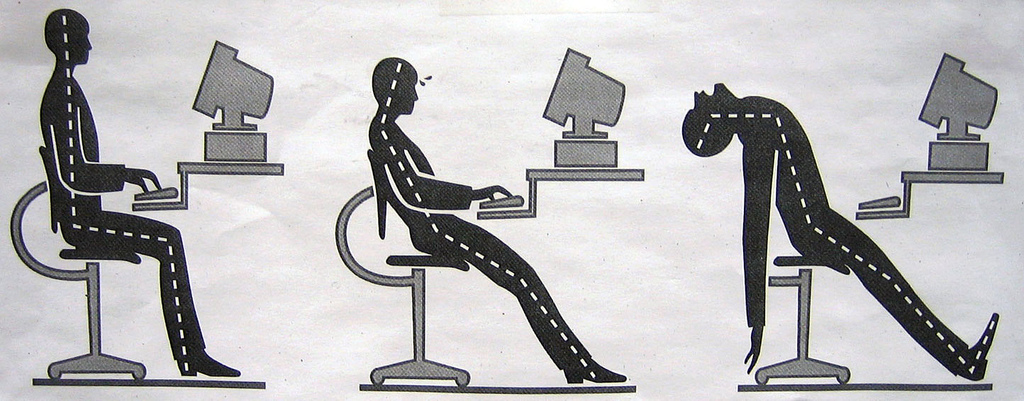
Pay attention to your posture and the posture of others around you.
Notice how the shoulders of some folks aren’t level. Sometimes one
shoulder can be higher than the other. Perhaps they do something
repetitive with the lower shoulder such as carrying a bag. This uneven
shift in weight could cause uneven wear and tear affecting other areas
of the body such as the spine or hips. Ever notice how people walk? I’ve
noticed that some people who are always in a hurry lean forward too
much as if they were walking down hill. They are always on the balls of
their feet. This posture places a lot of tension on the front part of
the body. Further down the road of life if this posture becomes habitual
these seemingly down-hill walkers may develop structural problems with
certain parts of the body such as the knees. Sitting up straight takes
pressure off the abdominal organs and allows the lungs to descend deeply
taking in more oxygen. Oxygen is required to energize our body.
Feelings of depression, stagnation and low energy can occur when we
collapse our posture preventing us from inhaling deeply. A good posture
is one that stands tall, straight, well rooted and balanced opening the
spaces between heaven and earth.
How can I develop a tall, straight, well-rooted and balanced posture?
I’m glad you asked this question! You have to first learn to recognize
good posture and then unlearn all the bad postural habits by promoting
your newly understood lessons on good posture. The following is a
checklist that can help you develop an understanding of goof posture. By
simply taking a minute to review this list on a daily basis you can
transform bad habits into good ones regarding posture.
It helps to face a full-length mirror to observe your posture. Before
you start have a friend take a picture of your current posture so you
can compare as time goes on.
· Stand with your feet shoulders-width apart – your weight should be carried on the center of your feet. Not on the sides, not the heels nor the balls of the feet but at the center of the feet where the arch of the foot is prominent.
· Bend your knees slightly – let your thighs carry your weight. Locking the knees blocks circulation. Don’t lock your knees.
· Thrust your hips forward slightly – this will open and lessen the curve of the lumbar section of the spine so the large and strong thigh muscles carry more of the weight.
· Lengthen the abdominal region – don’t collapse your abdomen. This will also help length the lumbar section and allow the abdominal organs such as the Large Intestine and Small Intestine to expand and open.
· Relax your shoulders, arms are placed by your side – Shoulders tend to rise up especially from over tensing. Allow them to settle. Next time you drive your car be aware of how relaxed your shoulders are. Your shoulders don’t need to be raised to steer the wheel.
· Slightly open the Axilla (Armpits) – when relaxing the shoulders maintain a small space in the axilla as if gently holding an egg so as not to obstruct the major blood vessels and nerves called the Brachial Plexus passing through the axilla.
· Press the Heavens – lengthen your neck – with the shoulders relaxed push upward with the top of your head as if you were pressing against the ceiling or the heavens depending on how tall you feel you are on any given day. This move also helps to open and expand the abdomen. Your feet should feel rooted to the earth as the top of your head pressed upwards to the heavens and these two moves will open the abdominal cavity – a.k.a. – the space between heaven and earth.
· Breath deeply – on a deep breath your abdomen should expand outward on inhalation. This deep breathing will expand the lungs wide and deep which will gently press and massage the spin and all the surrounding tissues and organs including the Heart, Liver, kidneys, Spleen, Large Intestine and Small Intestine to name a few. Breathing is an important part not to be discarded because it can physically connect with other internal organs to promote smooth and unobstructed circulation.
You may find that by making these steps a daily practice your body
begins to open and you may begin to experience new sensations such as
feeling lighter, more balanced, more energetic and more agile.
Observation and awareness can bring you a better quality of life
especially when you can begin to understand how these matters can
improve health and aid in the prevention of disease. Practice brings
perfection. Wasn’t mother always right?