How is Your Energy Level? High? Low? Irregular?
Awareness and Prevention Series: Diagnose Yourself Naturally
How’s your energy level? Do you feel you have low energy? Do you have
high levels of energy that others surprisingly comment on? Are your
energy levels inconsistent? Are there some days when you feel more
energy than other days. Do you feel lower or higher energy levels at
different parts of the day, month or year? Do you feel your energy level
has changed with age?
This article is part of a collection of articles entitled: Diagnose
Yourself Naturally – an Awareness and Prevention Program based on the
healing principles of Traditional Chinese Medicine, Tai Chi and Chi
Kung. If you’re interested in taking control of your health naturally
then you’ll want to take in the information presented here.
Qi (chee) is a concept in Traditional
Chinese Medicine also talked about in health-rejuvenating practices of
Tai Chi and Chi Kung. Let’s define Qi as ‘functional energy’. The
meaning of words from other languages can get lost in translation. I
think of Qi as something that flows to promote function and can be
evaluated subjectively through feeling.
The body has many functions. Eating, digesting, sleeping, eliminating
waste, thinking, moving, breathing, circulating blood, making blood,
healing and so much more. All these functions require Qi
(functional-energy).
Imagine that your house required 200 amps to power all electrical
devices. Now image how your house would function if the electric company
could only supply 100 amps of power. You begin to realize you will not
be able to fully run all your appliances. The same goes for the body.
Less qi can degrade or even turn off necessary body function. Poor
energy levels can lead to weight gain and a buildup of toxins in the
body that can lead to all kinds of trouble.
Your Qi (functional energy) needs to be sufficient and flowing to
maintain body function at the best level possible for optimal health.
Low energy, irregular energy, excessive energy… all can have an adverse
effect on body function. Balance and consistency are the keys to
regulating qi.
Regularity builds momentum – optimal body function
requires momentum. The body runs on cycles. When I think of a cycle I
think of a regular pattern that turns on and off or has peaks and
valleys. Sleep cycle, digestive cycle, activity vs rest,
inhaling/exhaling, blood circulation from contracting and relaxing heart
muscles and so on.
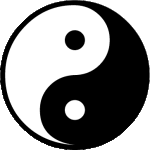
The necessary balance required in these natural cycles are captured in the spiraling Yin Yang diagram.
This diagram depicts the harmonious integration, support and transformation of two opposing forces for optimal function.
This natural truth, captured in this ancient Chinese symbol, is also
confirmed in the ancient Greek saying – everything in moderation,
nothing in excess. Regularity seeks to balance both extremes through
moderate cycles that gradually gain momentum. A lifestyle in the extreme
lacks the supportive cycling momentum and eventually becomes unbalanced
and leads to burnout.
Imagine journeying through life like riding a bicycle. You get to
choose which path to ride on. One path is easy to ride, straight and
smooth with very little ups and downs. The opposite path, like the roads
in Rhode Island, has an uneven surface filled with pot holes, and lots
of ups, downs and crazy turns.
The
former path will prove to be easier because it promotes consistency,
regularity and allows you to build momentum for future efforts. The
latter path will drain you of energy and leave you deficient. You energy
reserves are depleted. During stressful times, when you need a boost of
energy, it just won’t be there.
A medical doctor explains to me once that stress is good and it makes
you stronger. I say stress needs to be clarified because there are
limits. Stress in short, temporary burst, like exercising at a gym 3
times a week can be strengthening. The constant drip, drip, drip of
stress through everyday life is unsustainable. Your mind may convince
you that everything is good but your body will show the truth.
Stress reveals itself in a multitude of chronic ailments that people
struggle with today such as weight gain, diabetes, heart disease,
digestive disorders, poor sleep, anxiety, depression, hormone
irregularities, chronic fatigue, asthma, allergies and more. Stress
creates chaos in body function. When you experience multiple signs and
symptoms that don’t seem to tie together consider the possibilities that
stress could be the root cause.
Low energy – tiredness can be normal when you work
hard. Get a good night’s sleep and your back in the game. Chronic
tiredness may start to affect how the body functions. Sore muscles and
injuries may not heal completely. Toxins that seem to be everywhere
nowadays cannot be eliminated properly.
Appetite is low. Your ability to take in nourishment to support your
body is reduced. You may even have trouble sleeping because tiredness
creates irregularities in the natural cycles of body function including
the sleep cycle. Insufficient sleep leads to more tiredness, low
function and imbalances in the natural cycles of the body.
High energy – feeling anxious, moving fast, talking
fast, talking loud, shouting, aversion to heat, hot-headed temperament,
excessive appetite, feeling nervous, difficulty falling asleep, always
staying busy, can’t stop thinking, too much mental chatter and more.
There are many signs of high energy to observe but subjectively high
energy can make you feel anxious, hyperactive, unrealistically
super-strong, overly excited or nervous. We don’t have an infinite
supply of energy.
Burning a candle at both ends is not a practice in longevity. It may
offer more light but not for long. Practices in conserving energy can be
a better plan for longevity and optimal health.
If you want to increase vitality, experience greater health and
develop practices in longevity for life you’ll need to regulate your
energy.
When I ask a patient about the level of daily energy they experience
and they respond, “I have lots of energy”, I put a question mark there. I
wonder if that’s truly a healthy level being experienced.
If you experience a frantic pace to your daily activities you may be
overdoing it. You may be excessively draining your energy and developing
a bad habit. In the long run you won’t be able to maintain this pace.
Your mind will say go-go-go but your body will try to slow you down when
excess is present.
I’ve seen high energy people come into my clinic in their 40’s and
50’s complaining about fatigue and seemingly inexpiable and
uncontrollable weight gain. This is the body’s way of slowing you down
before you blow a fuse. Or it’s your body’s way of saying, “I am
exhausted and I’ve had enough”.
Your inner strength needs to be recharged and that can take a lot of effort.
The first step is to identify any bad habits that are draining your
energy. Next, get realistic as to what you are capable of accomplishing.
I see many lifestyles that are excessively busy and overwhelming. Just
when this busy body gets an extra 30 minutes in their day they pile on
another thing to do instead of taking a break.
Pacing yourself and knowing when to relax (restore) will better promote natural cycles and gain momentum for upcoming efforts.
Is your mind constantly in go-mode? Do you worry a lot? Do you
ruminate often? Do you have difficulty trying to get to sleep at night
because you can’t shut your mind down? Do you have digestive problems?
In the practice of Tai Chi we say the Mind leads the qi. Is your mind
writing checks your body can’t cash? Is your mind spending qi your body
can’t supply?
Activity and rest compliment and balance each other. Mental activity
needs to be balance with the opposite – rest. One type of meditative
practice is to try not to think or at least quiet the mind and think
less. This is a practice in turning off your mind. Some have difficulty
with this because they are not use to stillness but stillness is the
exact medicine that needs to be applied here.
Activity without awareness in relaxation is like mastering only 1
side of the equation. You have mastered a busy mind and have lost the
ability to relax, rejuvenate and restore. Regulating your mind means
becoming comfortable in stillness. A calm and focused mind will manifest
into healthy body function.
I’ve heard patients say they find it difficult to relax. Relaxing is a
practice in stillness. Developing a habit requires practice. Spend time
feeling comfortable in stillness can restore balance. This is not about
being lazy or doing less. This is about being smarter and building
momentum to naturally support cycles in body function. Your natural
level of energy should support your daily activities without leaving you
exhausted.
In Traditional Chinese Medicine,
ruminating thoughts and constant worry drain the qi (functional energy)
specifically needed for digestion. Chew on that for a while. Now isn’t
that an interesting expression? The energy pattern used for thinking and
eating correspond to each other. Overeating and overthinking will lead
to imbalances in health.
The mind needs to be regulated. Mental activity needs to be
organized. Meditation and stress relief techniques, particularly in
breathing, are essential for the busy mind. Herbal formulas can nourish
the body, clear heat and bring about a healthy sense of calmness but
practices that are excessive will always lead to exhaustion. Regulating
the mind gets to the root of the problem.
Irregular energy – consistency is the key to optimal
health. Consistency builds momentum. Less energy is used when
continuous cycles are built and supported by regularity and momentum.
Imagine your body burning fuel like an automobile. Everyone knows you
get better gas mileage on the highway compared to city driving. Why?
Powering up from a low speed to a high speed requires more power and
burns more energy than the power required to maintain a constant speed.
“Stop and go” is irregular and more rapidly depletes energy.
Daily routines that are well organized and seemingly flow without
much effort will conserve energy. A day full of poorly organized
routines, unknown or high expectations, and irregularities is a day of
frustration, tension and unnecessary stress that will exhaust energy and
will manifest into irregular body function.
Consistent energy
– The goal is to promote regular consistent energy to support body
function and daily routines. Take note of these words – regular,
consistent, routines vs irregular, inconsistent, chaos. Consistency
builds momentum. Consistency allows you to be more focused. When trouble
comes along you can handle it better. When you’re stressed out and your
daily habits are chaotic you will struggle. Stress and chaos will drain
your energy and leave you in a survival state that dysregulates body
function and leads to all sorts of confusing health issues that are hard
to figure out and unravel